
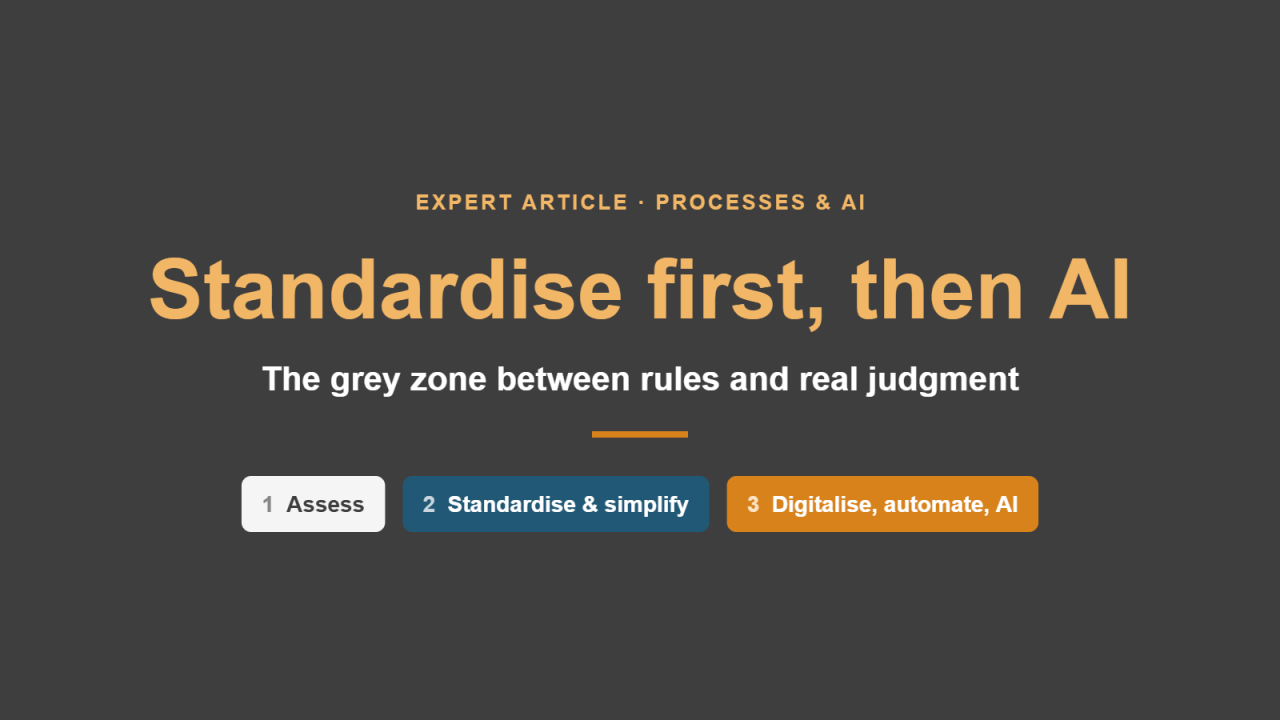
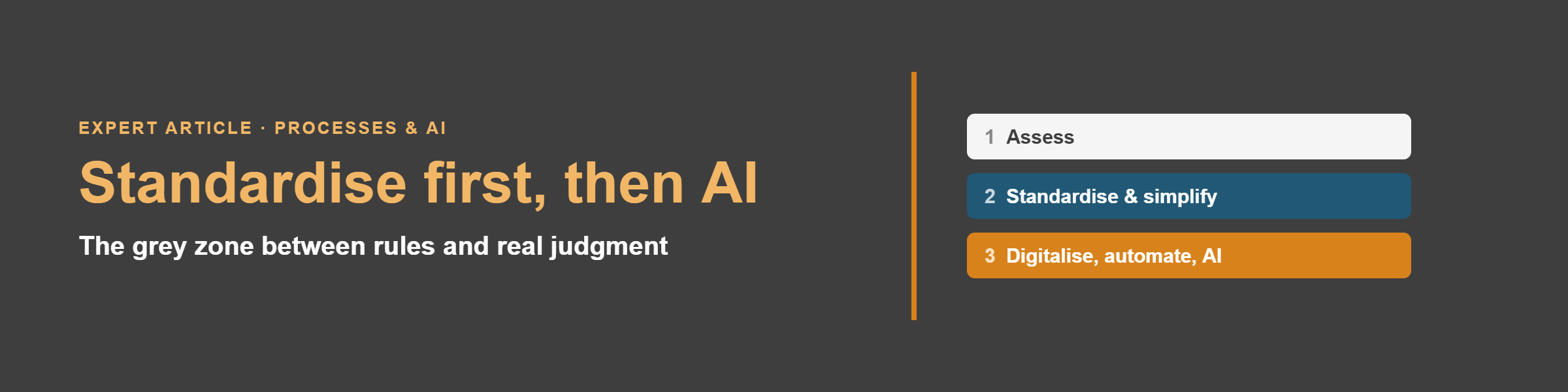
AI agents are now offered for almost every back-office task. Before you let one loose on a process, ask a simpler question first: does the process follow rules that nobody has written down yet? In our experience, a large part of everyday work sits in this grey zone between clear rules and real judgment. This article shows how to recognise it, why it pays to standardise it first, and the sequence we use: assess, standardise and simplify, and only then digitalise, automate and bring in AI.
In short
- The work in a typical back-office process falls into three parts: rule-based steps, steps that need real judgment, and a grey zone in between.
- The grey zone is usually rule-based as well; the rules just have not been written down. In our experience it can be about a third of the work.
- AI on an unstandardised process automates the variation: if three people do a task in four different ways, an AI agent will do it in four ways too.
- The sequence that works: assess the process and record its performance, standardise and simplify it, and only then digitalise, automate and bring in AI.
About this article
- Author: Zoltan Dobszai, CEO, Novacon
- Updated: October 2026
- Applies to: Back-office processes in finance, procurement and master data, in SAP-centric companies
- Technologies: Precisely Automate Evolve, QPR ProcessAnalyzer, Precisely Data Integrity Suite
- Reading time: 8 minutes
Based on our process improvement and automation projects across Europe.
Three kinds of workRules, judgment and the grey zone in between
Not every step of a process needs the same tool. Before choosing one, sort the steps by what they really require.
Rule-based work
The grey zone
Real judgment
Steps that follow fixed, documented rules. The same input always leads to the same output.
Steps that look like judgment calls but follow rules nobody has written down: who approves, which value goes into a field, when a case is escalated.
Steps that need context and interpretation: free-text emails, documents in changing formats, decisions on incomplete information.
Best handled by
Best handled by
Best handled by
- Workflows with business rules and approvals
- SAP automation from Excel or web forms
- RPA where systems cannot be connected directly, or doing so would cost too much
- The process first: map how it really runs
- Agree the rules with the process owner
- Then workflow, automation or AI, step by step
- People, supported by AI
- Generative AI and AI agents inside a governed workflow
Watch out for
Watch out for
Watch out for
- Exceptions that nobody planned for
- Rules that change while the automation stays the same
- AI that learns the variation instead of the rule
- Three people doing one task in four different ways
- No measured baseline for the AI result
- Data that nobody owns or can trace
In our experience, the grey zone is usually rule-based. Nobody has written the rules down yet.
Why standardise firstAutomating chaos creates faster chaos
Variation gets automated. If three people in a team do the same task in four different ways, an AI agent put on that task will also do it in four ways, or more, because prompts vary too. The agent can be tuned until its answers are consistent, but that work is standardisation, done in a more expensive place.
Predictability matters. With rule-based automation the same input always gives the same output, and every step leaves an audit trail. For posting to SAP, approving payments or changing master data, that predictability is a requirement, not a nice-to-have.
The right tool depends on the task. AI is strong where unstructured input has to be interpreted, such as an email, free text or a document whose format changes. A workflow gives the process one traceable, auditable path. RPA connects systems that cannot be connected directly, or only at too high a cost. The best results come where these work together.
Three misconceptions we still hear
- “Automation takes jobs.” It takes over tasks: copying, matching, updating statuses. Decisions, exceptions and customer contact stay with people, and those who know the process best become more valuable.
- “The new tool fits everything.” With RPA we saw every task as a nail. Rigid rules on a step that needs interpretation, or AI on a stable rule-based step, both give expensive and fragile results.
- “AI replaces the other tools.” AI, workflow and RPA each have their place. A good craftsman does not own only a hammer.
AI does not fix a process or its data. It amplifies what is already in it. Errors included.
How we do itThree steps before and with AI
We start from the business process, not from the tool. This is the sequence we have learned in a decade of work with Precisely technologies, and with QPR since 2023.
- AssessCurrent state, with QPR ProcessAnalyzer where possible
How the process really runs today, and a measured baseline.
- Standardise and simplifyRules and Lean
Agreed rules, and fewer variants, steps and approval loops.
- Digitalise, automate, AIAutomate Evolve, automation and AI
Digital tools secure the standard; we automate as much as possible and give AI the steps that need judgment.
1 · AssessHow does the process really run today?
What goes wrong
- Process maps show how work should run, not how it does
- Nobody knows exactly how long the process takes or how often it goes wrong
- Discussions run on opinions instead of facts
How we work
We assess the current processes and practices: how requests arrive, who does what, and where cases wait. Where the systems hold event data, we use QPR ProcessAnalyzer to reconstruct every case from SAP and other systems, so the variants, deviations and rework become visible. We record the current performance, such as lead time, first-time-right rate, rework and the share of exceptions. This is the baseline that all improvement is measured against.
What you get
- A picture of how the process really runs, with its variants
- A measured baseline: lead time, first-time-right rate, rework, exceptions
- A fact base for deciding where to start
2 · Standardise and simplifyAgree the rules, remove the waste
What goes wrong
- The same task is done in several different ways
- Approvals depend on who is asked, not on rules
- Exceptions are handled case by case and leave no trace
How we work
This is the rule-making stage, still without new digital tools. Together with the process owner we put things in order: every “it depends” in the grey zone becomes a rule or a documented decision, and we agree how the process should run. Then we improve it along Lean principles: we remove unnecessary variants, steps, approval loops and rework.
What you get
- A documented process standard, with business rules and approval logic
- Fewer variants, steps and approval loops
- Grey-zone cases turned into rules or documented decisions
3 · Digitalise, automate, AIDigital tools that secure the standard
What goes wrong
- Digital tools are put on a process that has no agreed standard
- AI is put on the whole process instead of the steps that need it
- Results cannot be compared with anything
How we work
Only now do we bring in digital tools, to secure the standards we have agreed. In Automate Evolve the process runs as a workflow: web forms, business rules, approvals and posting to SAP, with a defined route for exceptions and an audit trail. We automate as many tasks as possible, and give AI the steps that really need interpretation, such as reading a free-text request, classifying a document or proposing a decision. The AI step works inside the workflow, so its output passes the same rules and approvals as any other step, and its effect shows against the baseline.
What you get
- A workflow that enforces the standard, with an audit trail
- As many tasks automated as possible
- AI on selected steps, measured against the baseline
One level deeperIs the data in order too?
Once the process is in order, the next question is the data it relies on. The 2026 study by Precisely and Drexel University’s LeBow College of Business shows that leaders are more confident about their data than ready.
Governance is the weakest link. If a process has no owner, its data usually has none either. And AI learns whatever is in the data, errors included.
Perfect data never arrives. So we start narrow: one process, a measured baseline, and scaling only after the results are visible. For data quality rules, profiling and governance we use the Data Integrity Suite.
Three conditions for AI-ready data
- Quality: accurate, complete and consistent data.
- Governance: rules and owners that keep the quality over time.
- Context: where the data comes from, what it relates to and what it means.
Confidence vs. reality
88%
say their data is ready for AI
43%
name data readiness as the biggest obstacle to aligning AI with business goals
Governance
48%
have no programme yet to govern the data used for AI
39% see governance and compliance as a challenge
Data integrity challenges
From plan to execution
39 percentage points between starting and executing
Source: Precisely and Drexel University LeBow College of Business, 2026 State of Data Integrity and AI Readiness; 505 data and analytics leaders in the US, the UK, Germany and France.
Check your processFive questions before AI meets a process
- Can the process owner write down the rules of the steps you want to hand to AI?
- In how many ways does your team do the same task today?
- Do you know from data, not from opinions, where the process deviates?
- What is the baseline that the AI result will be measured against?
- Who owns the data that the AI will learn from or act on?

Where Novacon helpsFrom unwritten rules to measured results
Novacon is a process improvement company that uses technology, not the other way round. We have been a Precisely partner since 2016 and a QPR partner since 2023. This lets us take a process from unwritten rules to a measured workflow, and then decide with you where AI adds value.
SolutionProcess Automation & Digitalisation
SolutionData Governance
TechnologyQPR ProcessAnalyzer
Frequently asked questionsQuestions we hear most often
What is the grey zone in a process?
The part of the work that looks like it needs judgment but in fact follows rules nobody has written down, such as who approves what, or when a case is escalated. In our experience it is usually rule-based once the rules are made explicit.
What is the difference between a workflow and an AI agent?
A workflow runs defined steps and rules, so the same input always gives the same result, with an audit trail. An AI agent interprets context and can handle unstructured input, but its output can vary. They work best together, with the agent handling interpretation inside a governed workflow.
Which tools does Novacon use for this?
Precisely Automate Evolve for workflow and SAP automation, QPR ProcessAnalyzer for process mining, and the Precisely Data Integrity Suite for data quality and governance. The starting point is always the business process, not the tool.
Should a process be standardised before AI is used on it?
In most cases, yes. AI on an unstandardised process reproduces its variation, and without a baseline you cannot measure the result. Standardise the rule-based part first, and use AI where real judgment is needed.
How does process mining help before AI?
Process mining reconstructs how each case actually ran, from system event data. It shows the variants, deviations and rework, so you can see which steps can be put into rules and where judgment, and possibly AI, is needed.
How much of your process is grey zone? Let’s look at one process together.
ContactTalk to an expert
Tell us which process or AI use case you are looking at. One of our consultants will get back to you.
- We read your message and pass it to the consultant who knows the topic.
- We contact you to agree on a short call.
- If you wish, we show a demo on a process like yours.
Prefer to write directly?
info@novacon.hu
